The Collapse of the Roman Empire

Rome is the largest empire ever known in Western Eurasia. For more than four hundred years the empire stretched from the Hadrian Wall to the Euphrates River. The collapse of the Western Roman Empire was a setback caused by the failure of the empire to establish its authority. The Roman Empire also lost the power that allowed it to exercise effective control. There are at least eight factors that caused the collapse of the Roman Empire.

Invasion of the Barbarians
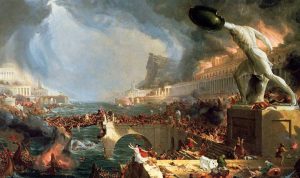
The simplest theory for the collapse of Western Rome was the consequence of a series of ongoing military losses from outside attacks. Rome had been in conflict with German tribes for centuries, but in the 300s “barbarian” groups like the Goths began to try to disrupt the borders of the Empire.

The threat became more apparent after the Romans faced a German rebellion at the end of the 4th century AD The German tribal attack became increasingly after in 410 King Visigoth Alaric managed to pillage the city of Rome. The Empire spent the next several decades under constant threat from German tribes before the “Eternal City” was raided again in 455, this time by the Vandals.

Finally, in 476 AD the Germanic leader Odoacer launched a rebellion and overthrew Emperor Romulus Augustulus. Since that time, no Roman emperor has ruled again from Italy. The fall of Romulus led many to regard 476 as the end of the Western Roman Empire.

Economic problems and dependence on forced labor
When Rome was attacked by troops from outside, the empire also suffered an economic collapse due to a severe financial crisis. Continual warfare and excessive spending significantly erode government cash. This condition is exacerbated by oppressive taxes and inflation which widens the gap between rich and poor. In hopes of avoiding tax officials, many members of the wealthy class even fled to the countryside and established independent territories.

At the same time, the empire was shaken by a labor deficit. Keep in mind, Rome’s economy depends on slaves to work on his fields and work as craftsmen. However, when the expansion stalled in the 2nd century, the supply of Roman slaves and other war treasures began to run low.

Another blow occurred in the 5th century, when the Vandals occupied North Africa and began disrupting imperial trade by wandering the Mediterranean as pirates. With a faltering economy and declining commercial and agricultural production, the empire began to lose its influence in Europe.

The Rise of the Eastern Roman Empire
The fate of Western Rome was largely determined at the end of the third century, when Emperor Diocletian divided the Empire into two parts – the Western Empire centered on the city of Milan and the Eastern Empire at Byzantium, which later became known as Constantinople. This division made the empire easier to regulate at first, but over time the two parts of the territory began to separate. The Eastern and Western Empires failed to work together to combat outside threats and both were often at odds over resources and military assistance.

As the gulf widened, the Eastern Empire, which was predominantly Greek, grew more prosperous while Latin-speaking Westerners entered into an economic crisis. More importantly, the strength of the Eastern Empire instead diverted the Barbarian invasion to the West.

Emperors like Constantin ensured that the city of Constantinople was fortified and well guarded, but Italy and the city of Rome – which only had symbolic value for many in the East – were left vulnerable. This Western political structure was finally destroyed in the fifth century, but the Eastern Empire lasted for a thousand years before being defeated by the Ottoman Empire in 1453.

Excessive Invasion and Overspending in the Military Field
At the height of its glory, the Roman Empire stretched from the Atlantic Ocean to the Euphrates River in the Middle East, however the splendor was also the beginning of its destruction.

With vast territories to govern, the empire faced administrative and logistical nightmares. Although they had a very good transportation system, the Romans could not communicate quickly or effectively enough to manage their territory.

Rome struggled to gather enough troops and resources to defend its borders from local uprisings and outside attacks. In the second century AD Emperor Hadrian was forced to build his famous wall in England only to keep the enemy at bay.

The large amount of funds channeled into the military maintenance of the empire did not necessarily make the empire survive, but instead caused the progress of Rome’s technology and civil infrastructure to slow down until it finally fell into ruin.

Corruption and Political Instability
Difficulties in managing large areas are compounded by ineffective and inconsistent leadership. Becoming a Roman emperor has always been a very dangerous occupation, because it can never escape the coup attempt of his political opponents.

Civil war pushed the empire into chaos. More than 20 people tried to usurp the throne within a span of only 75 years, usually the change of authority occurred after the previous emperor was killed. Praetorian guards – the emperor’s personal bodyguards – killed and installed new rulers as they pleased and even once auctioned the place to the highest bidder.

Political decay also extended to the Roman Senate which failed to quell the excesses of the emperors because of corruption and its inability to be a public secret. When the situation worsened, community pride diminished and many Roman citizens lost faith in their leaders.

The arrival of the Huns and the barbarians’ migration
Barbarian attacks in Rome originated in part from mass migration caused by the invasion of Huns in Europe at the end of the fourth century. When the Eurasian soldiers raged in northern Europe, they drove many Germanic tribes to the borders of the Roman Empire.

The Romans reluctantly allowed members of the Visigoth tribe to cross south of the Danube and enter into the security of a safe Roman territory. But they also treated the Visigoths cruelly.

According to historian Ammianus Marcellinus, Roman officials even forced starving Goths to exchange their children for slavery in exchange for dog meat. It can be said that the Romans created dangerous enemies within their own borders.

When the oppression became more severe to bear, the Goths rose to revolt and eventually defeated Roman forces and killed Emperor Eastern Valens at the Battle of Adrianople in 378 AD.

The Romans who were shocked at the event negotiated a fragile peace with the barbarians, but the truce ended in 410, when the Goth King Alaric moved west and pillaged Rome.

As the Western Empire weakened, Germanic tribes such as the Vandals and Saxons could move across the border and occupy Britain, Spain and North Africa.

The Rise of Christianity and the Loss of Traditional Values
Rome’s decline was linked to the spread of Christianity and some argue that the emergence of a new faith helped contribute to the downfall of the empire. The Milan Decree legalized Christianity in 313 and then became the state religion in 380. These decrees ended centuries of persecution, but they might also erode the traditional Roman system of values.

Christianity replaced Roman polytheistic religion which saw the emperor as having divine status. Meanwhile, the pope and other church leaders are taking an increasing role in political affairs, which further complicates governance.

18th-century historian Edward Gibbon is the most famous supporter of this theory, but his views have since been widely criticized. While the spread of Christianity might play a small role in limiting Roman civil policy, most scholars now argue that the influence of Christianity is somewhat minor when compared to military, economic and administrative factors.

Weakening Roman Legion
For most of its history, the Roman military was one of the greatest powers in ancient times. But during the setbacks, the once mighty legions began to change.

Unable to recruit enough troops from Roman citizens, emperors such as Diocletian and Constantine began hiring foreign mercenaries to support their armies.

Rome’s legions were eventually filled with German Goths and other barbarians. They were so numerous that Rome began to use the Latin word “barbarus” to refer to “soldiers.”

These Germans were known as fierce warriors, but they had little or no loyalty to the empire. Even their power-hungry officers often turned against their Roman masters. The climax was when many barbarians who were previously joined in the legions looted the city of Rome and brought down the Western Empire forever.
History of Democracy

Democracy is derived from the Greek “democracy” which means people’s government. Popular government is a government in which everyone has a voice about what needs to be done. The history of democracy itself is believed to have its roots in ancient Greece around two and a half millennia ago (around the sixth century BC).

Birth of Democracy
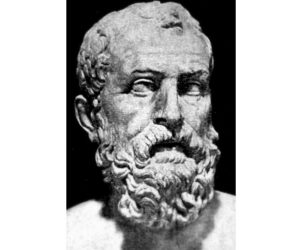
In Greece, Athens MP named Solon (around 630-560 BC) presented an early version of participatory democracy, which was mixed with elements of social justice.

It aims to correct government control that is exclusive and oppressive (oppressive). This desire arose because at that time wealthy landowners used their influence to exploit a severe economic crisis. They seized the wealth and freedom of the poor population.

Solon who was elected as chief judge in 594 BC then began to oppose the rulers. Reforms aimed at repairing flawed systems are carried out by limiting the absolute power of the upper classes.

In practice Solon limited the influence of the rich and introduced a more humane and balanced legal code. He also increased the role of the People’s Assembly by creating Boule (multi-ethnic council of middle-income citizens), then limiting the authority of the Best Male aristocratic Council (Areopagus).

In 510 BC, Cleisthenes (around 570–507 BC) continued Solon’s constitutional reorganization. He made the People’s Assembly the only legislative body, increased the influence of Boule, seized the effective power of Areopagus, and ensured wide and deep participation in public life.

In Athens, the government allowed all free adult men who were citizens to vote, whether rich or poor. Unfortunately the system has flaws because it does not accommodate women’s rights in politics.

When democracy began to function in Athens, many other city states chose to implement the system in their government. But the opportunity to vote is less than that imposed in Athens.

Most other city-states only allow adult male citizens to choose if they own land or own their own home (ie, rich people). They also don’t let women choose.

One big problem for democracy in ancient times was the lack of time for men to always go to the meeting place to vote.

Most men have jobs, grow rice, make shoes, fight or whatever. They cannot always argue and choose. Therefore, finally some people were chosen who would carry out most of the voting (representative model) and the rest only came when there was a very important vote.

In Athens, people who are representatives of the people are chosen by lottery. The man who wins in the lottery has the right to sit on the Council of 500. Then he will serve for a year on the council.

Development of Democracy
Starting from Ancient Greece, then democracy spread to the region around the Mediterranean. However, democracy in this region was almost destroyed by the Roman Empire around 100 BC.

On the other hand, places like Athens continued to use democratic methods to make their own decisions on local matters for a long time after that.

A thousand years later, in the Middle Ages, several cities in Italy – Siena, Florence, Genoa, Pisa, Venice – returned to democratic rule after Matilda of Canossa died. These democracies are all organized in slightly different ways, but none of them allows the poor, women, or children to vote, and some have a lottery system like Athens.

Farther north in England, some men had the right to elect local officials and their representatives in Parliament in the Middle Ages, but the king still held most of the power.

This Italian democracy, too, was finally conquered by the Holy Roman Empire and ruled by the German emperor.

Starting in the 1600s, people began to struggle to realize democracy again. In England, Cromwell seized power to form Parliament. In America, the Revolutionary War gave birth to the Constitution in 1789. The constitution allowed adults to choose freely if they owned their own agriculture or business.

A few years later, the French Revolution brought democracy to France (for a short time). In the early 1900s, democracy entered Spain – for a while. Even though countries that embraced democracy began to emerge, women’s right to vote was still severely restricted.

Today many countries embrace a form of democracy. In the 20th century. most poor people, people of color, and women have won the right to vote, even though children and foreigners still cannot.

Even though countries that embrace democracy have mushroomed, the amount of power available to voters still varies from country to country and some Middle Eastern countries such as Saudi Arabia still have not implemented this system.

World War II

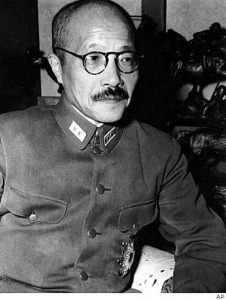
World War II is considered one of the biggest and deadliest conflicts in the history of mankind. The war involved many countries and fought on the battlefield in Europe, North Africa, Asia and the Pacific. Broadly speaking the war was divided into two blocks, the Allied bloc (Great Britain, the Soviet Union, and the United States) against the strength of the Axis bloc (Germany, Italy, and Japan).

Background of World War II

The seeds of World War II are derived from a lame resolution post-World War I. The Peace Conference and the Versailles Agreement that ended World War I produced huge profits for the winner (the Allies), while the losing party (the central axis) received unfair treatment. Germany became the most disadvantaged country due to the Versailles Treaty.

In particular, political and economic instability in Germany due to the Treaty of Versailles pushed Adolf Hitler and his Socialist National Party (Nazis) to power in Germany.

After becoming Chancellor of Germany in 1933, Hitler quickly consolidated power. He named himself with the title of Führer (supreme leader) in 1934.

Hitler was very obsessed with the idea of ​​the superiority of the pure German race called the Aryan race. He believes that war is only a way to get the living space needed for the race to develop.

In the mid-1930s, he began to rearm Germany secretly and violated the Treaty of Versailles. After signing alliances with Italy and Japan to fight the Soviet Union, Hitler sent troops to occupy Austria in 1938 and the following year annexed Czechoslovakia.

When Hitler’s aggression was getting out of control, the United States and the Soviet Union were preoccupied with domestic problems, so the German problem was a little neglected. Meanwhile France and Britain (the two other countries most devastated by World War I) wanted to avoid confrontation, so they temporarily preferred to remain silent.

Outbreak of World War I
In late August 1939, Hitler and Soviet leader Joseph Stalin signed the German-Soviet Non-Aggression Pact. This agreement that sparked anxiety London and Paris.

Hitler had long planned an invasion of Poland, a country where Britain and France had guaranteed military support if attacked by Germany. The pact with Stalin guaranteed Hitler would not face war on two fronts when he invaded Poland and would instead receive assistance from the Soviets.

On September 1, 1939, Hitler invaded Poland from the west; two days later, France and Britain declared war on Germany and marked the start of World War II.

On September 17, Soviet troops invaded Poland from the east. Under attack from both sides, Poland fell quickly. Entering early 1940 Germany and the Soviet Union had divided control over Poland.

The Stalin army then moved to occupy the Baltic States (Estonia, Latvia and Lithuania) and defeat Finland which provided fierce resistance in the Russo-Finish War.

At sea, the British and German naval fleet fought a fierce battle. German submarines U-boats began attacking merchant ships bound for England, resulting in more than 100 ships sinking in just four months since the war began.

Six months after the invasion of Poland, news about the war has not been widely trusted. Even many Europeans thought the war was just a fake war. But this condition turned into panic after the war raged in Western Europe.

World War II in Western Europe (1940-1941)
On April 9, 1940, Germany simultaneously invaded Norway and occupied Denmark. This German invasion marked the beginning of a real war.

On May 10, German troops swept Belgium and the Netherlands in what became known as the “blitzkrieg” or lightning war. Three days later, Hitler’s forces crossed the Meuse River and attacked French troops in Sedan which was located at the northern end of the Maginot Line. Keep in mind that the defense at Sedan is a complicated defense chain that was built after World War I and is considered an impenetrable defense barrier.

Nevertheless the Germans broke through the ranks with their tanks and planes and proceeded to move forward. British Expeditionary Force (BEF) were evacuated by the sea from Dunkirk in late May, while in the south of the French troops struggled to defend their territory.

When France was on the verge of collapse, the Italian fascist figure, Benito Mussolini, entered into a cooperation agreement with Hitler. Furthermore Italy declared war on France and Britain on 10 June 1940.

On June 14, German troops entered Paris. A new government formed by Marshal Philippe Petain (French hero of World War I), he then asked for a ceasefire two nights later.

France was finally divided into two zones, one under German military occupation and the other under the Petain government, which was based in Vichy.

After Paris was captured, Hitler now turned his attention to England. In contrast to France, England has a defensive advantage because it is separated by the English Channel.

To pave the way for an amphibious invasion, German aircraft began to bombard British territory throughout the summer of 1940. The German effort resulted in many civilians being victimized and damaging to industrial centers.

When the British conditions were pressed, there was a shock in the war in the West. The Royal Air Force (RAF) defeated the Luftwaffe (German Air Force) in the Battle of Britain. This German defeat made Hitler postpone his plans to occupy England.

Britain can breathe a little, when their resources are running low that America comes to help with the logistical shortcomings of the war.

Operation Barbarossa (1941-1942)
In early 1941, Hungary, Romania and Bulgaria joined the Axis block. The joining of these countries was followed by German attacks on Yugoslavia and Greece in April.

Hitler’s conquest of the Balkans was the first step towards an invasion of the Soviet Union. The vast area of ​​the USSR is expected to be a living space for the development of the Aryan race.

In addition to being the first step to conquering the Soviet Union, the Balkan conquest was also part of Hitler’s strategy to exterminate Jews in Europe. Many European Jews settled in the Soviet Union.

Hitler considered Jews to be the cause of economic and political instability that plagued Europe. As the planner of the genocide plan, he entrusted to Heinrich Himmler, the German police chief.

The Holocaust coincided with an attack on the Soviets. Over the next three years more than 4 million Jews were slaughtered in concentration camps established in Poland and Austria.

On June 22, 1941, Hitler ordered the invasion of the Soviet Union, codenamed Operation Barbarossa. Although the number of Soviet tanks and aircraft far exceeded Germany, their technology was outdated. As a result, Germany managed to approach Moscow in mid-July.

However, the misunderstanding between Hitler and his commander on the field was coupled with the Russian winter which was known to violently delay the progress of the German invasion.

Pacific War (1941-1943)
At a time when the Allies in Europe were overwhelmed by the German invasion, the United States was the only country capable of resisting Japanese aggression in Asia.

On December 7, 1941, the Japanese Prime Minister deployed 360 Japanese aircraft to attack the main US naval base at Pearl Harbor in Hawaii. The attack shocked Ameria and scowled more than 2,300 troops.

The attack on Pearl Harbor apparently succeeded in uniting American public opinion to support the US joining World War II. On December 8, Congress declared war on Japan. The joining of the US into the war was immediately responded by Germany and other Axis powers by declaring war on the United States.

After a series of Japanese victories, the US Pacific Fleet won the battle in June 1942. This victory is widely believed to be a turning point in the war.

On Guadalcanal, one of the southern Solomon Islands, the Allies successfully fought Japanese forces in a series of battles from August 1942 to February 1943.

In mid-1943, Allied naval forces began an aggressive counterattack against Japan. This attack involved a series of amphibious attacks on the main islands occupied by Japan in the Pacific.

This “island-jumping” strategy proved successful and the Allied forces moved closer to their final destination to attack the Japanese island.

The Allies Turn the situation around (1943-1945)
In North Africa, British and American forces defeated Italy and Germany in 1943. The Allies then severely beat Italy with invasions in Sicily and Italy. The Allied counterattack caused the Mussolini government to fall in July 1943.

On the Eastern Front of World War II, a Soviet counterattack launched in November 1942 ended the protracted Battle of Stalingrad.

The impact of winter, along with the reduced supply of food and medicine, ended the German forces. The last German troops on the Eastern Front surrendered on 31 January 1943.

On 6 June 1944 – celebrated as D-Day, the Allies began a full-scale invasion of Europe. Around 156,000 British, Canadian and American troops on the coast of Normandy, France.

As a form of response, Hitler concentrated all the remaining strength of his troops in Western Europe. This concentration made the Soviet Army free to advance to Poland, Czechoslovakia, Hungary and Romania. After gathering troops, Hitler attempted to drive the Americans and British back from Germany in the Battle of the Bulge (December 1944-January 1945), the last major German offensive in the war.

An intensive aerial bombardment in February 1945 preceded the Allied ground invasion of Germany. German troops could not turn things around, their conditions became even more unclear after Berlin was surrounded.

Germany officially surrendered on May 8 Soviet troops occupied most of the country. Meanwhile German leader Adolf Hitler died after killing himself on April 30 in his Berlin bunker.

End of World War II
At the Potsdam Conference in July-August 1945, US President Harry S. Truman (who had served after Roosevelt’s death in April), Churchill and Stalin discussed the ongoing war with Japan and the settlement of peace with Germany.

Postwar Germany will be divided into four occupation zones which will be controlled by the Soviet Union, Britain, the United States and France.

For the future of Eastern Europe, Churchill and Truman tried to discuss with Stalin, because they still needed Soviet assistance in the war against Japan.

The great casualties suffered by the Allies in the wars in Iwo Jima (February 1945) and Okinawa (April-June 1945) caused Truman to permit the use of new and powerful weapons – atomic bombs – in the Japanese cities of Hiroshima and Nagasaki in early August.

On August 10, the Japanese government issued a statement stating that they would accept the terms of the Potsdam Declaration. On September 2, US General Douglas MacArthur accepted the official surrender of Japan aboard the USS Missouri in Tokyo Bay.

World War II proved to be one of the most devastating international conflicts in history. The war claimed around 35 to 60 million lives, including 6 million Jews who died at the hands of the Nazis. Millions more were injured and many people lost their homes and property.

Post-World War II, Communism and Liberalism spread throughout the world. The spread of the two ideologies was followed by the emergence of two superpower countries, the United States and the Soviet Union which competed for competing influence in the world.

Ancient Persian Empire

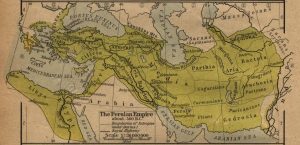
The Ancient Persian Empire was the first superpower empire centered on the land of Iran. The first Persian Empire was founded by Cyrus the Great around 550 BC and became one of the greatest empires in history. The Kingdom of Cyrus stretches from the European Balkan Peninsula in the West to the Indus Valley of India in the East.

This dynasty, sometimes referred to as the Achaemenid Empire, was the center of world cultural, religious, scientific, artistic and technological civilization for more than 200 years before it fell to Alexander the Great.

Cyrus the Great: Founder of the Persian Empire

Cyrus II was one of the greatest kings of ancient centuries. Although he is the grandson of the famous King Mendes, Astyages, the king actually wanted to kill his grandson.

The plot of the murder was planned when Cyrus was born. But he survived after the shepherd who was assigned to kill him actually saved him.

He grew up in a shepherd family, before finally at the age of 10 he returned to his original parents, the daughter of Mandane and King of Persia Cambyses I.

Growing up in a family that was always oppressed by the kingdom of Mendes, Cyrus also made him hate his grandfather. After replacing his father in 559 BC, Cyrus then led the war against his grandfather in 553 BC.

The war that lasted for three years finally ended with Cyrus’ victory. The victory marked the founding of the Persian Empire in 550 BC.

Government system of the Persian Empire
The first Persian Empire under Cyrus the Great soon became the world’s first superpower empire. The empire succeeded in establishing a unitary government that controlled the three most important sites of early human civilization: Mesopotamia, the Nile Valley of Egypt and the Indus Valley of India.

At its peak, the Persian Empire stretched from the Balkan Peninsula in Europe – in parts of what is today Bulgaria, Romania and Ukraine – to the Indus River Valley in northwestern India and south to Egypt.

There is a characteristic of the Persian conquest, rather than destroying the local economy for their own selfish advantage, the Persians chose to work to increase trade throughout their empire. They standardize the scales, develop official coins, and apply universal laws.

Persian leaders are obliged to be cooperative and impose a 20 percent tax on all agriculture and manufacturing. They also impose a tax on religious institutions, which despite their previous wealth are not taxed.

Meanwhile, the Persians themselves were not taxed.

Persian kings – especially Cyrus and, later, Darius I (522-486 BC) – developed a model for the administration of a large kingdom which was followed by other kingdoms in the future. The law is applied fairly and equally among all different subjects.

Based in the capital city of Persepolis, Darius I divided their kingdom into 20 provinces run by satrap (governor). Local residents then provide land to feudal landlords in return for loyalty and security guarantees from the Persian army. Most of the people in the empire on average work as farmers or craftsmen.

The Persian capital, Persepolis, located in southern Iran is among the largest archeological sites in the world. Persepolis was included in the UNESCO world heritage site in 1979.

The Achaemenia Persepolis Palace was built on a very large terrace. They are adorned with ornamental facades that include sculptures of the famous ancient Persian long stone reliefs.

So that large areas are well managed, of course, requires good communication. For this reason, Cyrus built the foundations of a courier system, or mail. Darius I then built a communication network that connected most of the empire.

A 1,600-mile highway was built from Sardis to Susa, one of the administrative capitals. Along this road, there are many places for lodging, where royal couriers can get horses and fresh supplies.

Culture of the Ancient Persians
Ancient Persia created art in various forms, including metal, stone carvings, weaving and architecture. When the Persian Empire expanded to include the artistic center of other early civilizations, various new cultures were formed from the influence of Persian culture.

Early Persian art included large stone reliefs carved into the cliffs, such as those found at Naqsh-e Rustam, an ancient tomb filled with the tombs of the Achaemenid kings. In that place, there are intricate stone murals depicting scenes of riding and battle victories.

The ancient Persians were also known for their metals. In the 1870s, smugglers found gold and silver artifacts among the ruins near the Oxus River in Tajikistan today.

Artifacts include small gold trains, coins, and bracelets adorned with griffon motifs. (Griffon is a mystical creature with eagle wings and head and a lion’s body, and a symbol of Persian persepolis.)

British diplomats and military personnel serving in Pakistan brought around 180 of this gold and silver – known as the Oxus Treasure – to London where they are now kept in the British Museum.

The history of woven carpets in Persia comes from nomadic tribes. The ancient Greeks loved this hand-woven carpet art. The carpets are famous for their intricate designs and bright colors.

Ancient Persian Religion
Many people consider Persia to be a synonym with Islam, although Islam only became the dominant religion in the Persian Empire after the conquest of Arabia in the seventh century. The first Persian Empire was formed by a different religion: Zoroastrianism.

The name of the religion comes from the Persian prophet Zoroaster (also known as Zarathustra). Zoroastrianism is arguably the first monotheistic religion in the world. Until now the religion is still practiced as a minority religion in parts of Iran and India.

Zoroaster, who probably lived between 1,500 and 500 BC, taught his followers to worship one god, not many, as previously Indo-Iranian groups worshiped.

The Achaemenian kings were devout Zoroastrians. According to most accounts, Cyrus the Great was a tolerant ruler who allowed his people to speak their own language and practice their own religion. Although he himself adhered to the Zoroastrian Asha (truth and truth) law, he did not impose Zoroastrianism on people from the territories conquered by Persia.

The Hebrew scriptures praise Cyrus for freeing the Jews in Babylon and allowing them to return to Jerusalem.

Subsequent rulers in the Achaemenid Empire followed Cyrus’s model of approach to social and religious affairs, thus enabling the diverse Persians to continue practicing their own way of life. This time period is sometimes called Pax Persica or Persian Peace.

The collapse of the Persian Empire
The Persian Empire entered a period of decline after the failure of Xerxes I’s invasion of Greece in 480 BC. The management of expensive Persian lands also consumed the imperial treasury. This condition causes the imposition of high taxes for the Persians.

The Achaemenid Dynasty finally fell to Alexander the Great in 330 BC. The next ruler tried to restore the glory of the Persian Empire, but the empire never reached the level of glory that had been achieved by Cyrus the Great and Darius I.

History of the Great Wall of China

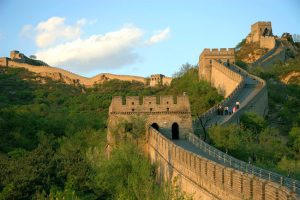
The Great Wall of China is a series of ancient walls and fortresses located in northern China. This wall has a length of 21,196.18 kilometers.

The Great Wall of China is China’s best-known symbol and has a long history. Initially the wall was built by Emperor Qin Shi Huang in the third century BC. as a means to prevent attacks from the Xiongnu and other nomadic tribes.

For more than 2,000 years the construction of the wall was continued by the Chinese authorities. The most famous and preserved part of the Great Wall was built in the 14th to 17th centuries, during the Ming dynasty. Although the Great Wall has never effectively prevented the invaders from entering China, it serves as a tangible symbol of Chinese civilization that has existed for a long time.

Qin Shi Huang and the Beginning of the Construction of the Great Wall of China

The construction of the Great Wall of China can be traced to the 3rd century BC, but many fortifications including the inside of the wall have been built hundreds of years before. The fortresses were built when China was divided into several warring kingdoms.

Around 221 BC, Qin Shi Huang, the first emperor to unite China under the Qin Dynasty, ordered the removal of defense posts between countries and united a number of walls along the northern border into one defense system. The wall was then extended by more than one 10,000 li (li is about one third of a mile). The aim of this project is to protect China from the attack of nomadic tribes in the north.

The construction of the Great Wall of China became one of the most ambitious development projects ever undertaken by any civilization. The famous Chinese general Meng Tian was in charge of the project.

According to some accounts it is said that the construction of the Great Wall of China used troops, prisoners, and commoners as workers.

Most of the Great Wall of China is made of earth and stone. The wall stretches from the port of the Shanhaiguan Chinese Sea more than 3,000 miles west to Gansu province. In some strategic areas, parts of the wall are overlapped for maximum security.

The wall has a foundation as high as 15 to 50 feet, then a height of about 15-30 feet and topped with a fort as high as 12 feet or higher. The building also features a guard tower that is placed along the wall interval.

When Emperor Qin Shi Huang ordered the construction of the Great Wall around 221 BC, the workforce that built the wall consisted mainly of soldiers and prisoners. It is said that as many as 400,000 people died during the construction of the wall. Many of these workers were buried in the walls themselves.

The Great Wall of China in Cross History
With the death of Qin Shi Huang and the fall of the Qin Dynasty, many parts of the Great Wall were damaged. After the next dynasty, the Han Dynasty also collapsed, a series of border tribes controlling northern China.

Among the most powerful of the tribes was the Northern Wei Dynasty. When in power this dynasty repaired and expanded the existing wall to defend against attacks from other tribes.

Bei Qi Kingdom (550-577) built or repaired walls of more than 900 miles. Repair and expansion were then continued by the short-lived Sui Dynasty (581–618).

With the fall of Sui and the rise of the Tang Dynasty, the Great Wall lost its function as a fortress, because China had defeated the Tujue tribe in the north and expanded its territory beyond the original border protected by the wall.

During the Song Dynasty, the Chinese were forced to retreat under threat from the Liao and Jin people in the north who took over many areas on both sides of the Great Wall. The powerful Yuan (Mongol) dynasty (1206-1368), founded by Genghis Khan, eventually controlled all of China, parts of Asia and parts of Europe.

Although the Great Wall was not so important to the Mongols in particular as a military stronghold, the soldiers were still assigned to the wall to protect merchants and caravans traveling along the Silk Road trade routes.

Construction of the Ming Dynasty Wall
Despite its long history, the Great Wall of China as it is today is mostly built during the Ming Dynasty (1368-1644).

Like the Mongols, the early Ming rulers were less interested in building border fortifications, and building limited walls until the end of the 15th century.

In 1421, emperor Ming Yongle proclaimed China’s new capital, Beijing, at the site of the former Mongol city of Dadu. Under the cold rulers of the Ming rulers, Chinese culture flourished, and the period saw a large amount of construction alongside the Great Wall, including bridges, temples and pagodas.

The construction of the Great Wall as it is known today began around 1474. After the initial phase of regional expansion, the Ming rulers largely took a defensive stance and the expansion of the Great Wall was the key to this strategy.

The Great Wall of China in Modern Times
In the mid-17th century, Manchus from central and southern Manchuria broke through the Great Wall and entered Beijing. In the end they forced the Ming Dynasty to abdicate, while also marking the beginning of the Qing Dynasty.

Between the 18th and 20th centuries, the Great Wall emerged as China’s most common symbol for the Western world, and both physical symbols – as manifestations of Chinese power – and psychological representations of barriers maintained by the Chinese state to repel foreign influence and exert control over its citizens.

Today, the Great Wall is generally recognized as one of the most impressive architectural achievements in human history. There was an effort to maintain the structure of the wall, but a more concrete step was only realized in 1980, when China made the wall a tourist attraction and source of income.

In 1987, UNESCO established the Great Wall as a World Heritage Site, and popular claims that emerged in the 20th century stated that this wall was the only man-made structure seen from space.

The Chinese Revolution

The Chinese Revolution of 1911 was a revolution that succeeded in overthrowing the last imperial dynasty of China (Qing Dynasty) and establishing the Republic of China (ROC). This revolution also started a series of revolutions that occurred in China during the 20th century.

Background of the Chinese Revolution
The modern period of China opened with the first defeat of the West in the First Opium War in 1842. Since then the Qing palace ruled by ethnic Manchus has struggled to withstand foreign interference to China.

However, efforts to adjust and reform traditional methods of governance are limited by a very conservative court culture that does not want to give too much authority to reform.

After the defeat of the Second Opium War in 1860, Qing tried to modernize by adopting certain Western technologies through the Self-Strengthening Movement from 1861. In the war against Taiping (1851-64), Nian (1851-68), Yunnan Muslims (1856-68) ) and the West Sea (1862-1777), traditional imperial forces proved to be incompetent and showed a weak imperial government.

In 1895, China suffered another defeat during the period of the First Sino-Japanese War. This defeat shows that traditional Chinese feudal society also needs to be modernized if it wants to achieve technological and commercial progress.

The combination of increasing imperialist demands (from Japan and the West), frustration with the Qing court and a desire to see a unified China led to the emergence of nationalist movements that carried revolutionary ideas.

These revolutionary ideas were echoed by the Chinese living abroad, especially in Southeast Asia and America. Those who were mostly Western-educated academics began to press for either direct reform or revolution.

Kang Youwei and Liang Qichao emerged as their leaders who proposed the establishment of a constitutional monarchy.

While Sun Yat-sen led a mixed group which together formed the Revolutionary Alliance or Tongmenghui. The Revolutionary Alliance has a mission to replace the Qing government with a republican government, Sun himself is a nationalist with some socialist tendencies.

Both revolutionary leaders and overseas Chinese who are financing their efforts are rooted in southern China. The Revolutionary Alliance had carried out a number of rebellion attempts against the Qing in the years leading up to the revolution, but all were successfully stopped by the Qing army.

The outbreak of the revolution
On October 10, 1911, the rebellion in Wuchang became the starting point for a national scale uprising. When his losses increased, the Qing court responded positively to a series of demands intended to turn the imperial authoritarian rule into a constitutional monarchy. They appointed Yuan Shikai as the new prime minister of China, but before he was able to reclaim the captured territories from the revolutionaries, the provinces began to declare their allegiance to the Revolutionary Alliance led by Sun Yat Sen.

Dr. Sun himself was in the United States on a fundraising tour at the time the uprising began. He rushed first to London and Paris to ensure that the two countries would not provide financial or military support to the Qing government in its struggle.

By the time he returned to China, the revolutionaries had taken over Nanjing, the former capital under the Ming Dynasty, and representatives from the provinces had begun to arrive for the first national meeting. Together, they chose Dr. Sun is the temporary president of the newly established Republic of China.

Premature Revolution
Sun Yat-Sen’s dream of forming the Republic of China has been achieved, but the process of consolidating the new government is far more difficult than predicted by revolutionaries.

The overthrow of the Qing Dynasty did not bring an era of peace and prosperity, but a period of chaos, social unrest, disappointment, and prolonged war. In collective memory, the Republican era is not related to the rebirth of China, but to warlords, corruption, economic weakness, civil strife and foreign aggression.

Sun Yat-sen’s position as Provisional President himself did not have much influence on the stability of the new nation.

Although the Republic was proclaimed in January 1912, the Qing Dynasty did not simply renounce its title and did not recognize the republic’s government as a legitimate government. Because there was no official resignation, de facto China had two governments, the Republic and the Empire. Sun Yat-sen’s duty was to lead the Republic of China until the QIng Dynasty resigned and the condition of the country was stable.

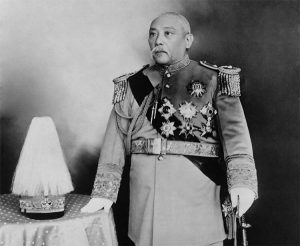
During the revolution Yuan Shikai emerged as the most powerful politician in the imperial court. His personal ambitions led him to adopt a pragmatic attitude towards the Qing and revolutionaries, so he chose to play the role of mediator between the Republic and the Qing Dynasty.

However, Yuan Shikai realized that his political career would not last long if he sacrificed himself for the Qing Dynasty. Therefore, he then changed his strategy. He tried to solve the crisis by ensuring a smooth transition from the Empire to the Republic. Yuan presented himself as a peacemaker and loyal servant of the new country.

The Imperial Family was divided between those who preferred resignation and those who wanted to suppress the revolution. Yuan Shikai explained to the imperial family that if they wanted to fight the revolutionaries, they had to prepare 12 million taels to finance the war. But the imperial treasury was empty and no Manchu prince was prepared to sacrifice his personal wealth to pay for the army

On January 26, 1912, the imperial cabinet met at Yuan Shikai’s residence. Forty high-ranking Yuan officers sent telegrams urging the Manchu to abdicate. That night, Liangpi, the army chief of staff, was killed by a fanatical revolutionary on his way home. After this murder, fear of security swept through the imperial family.

On January 27, Empress Longyu Empress Longyu, the wife of the late Emperor Guangxu and the adopted mother of the last Emperor of China, Puyi, frantically begged Yuan Shikai’s deputy to convey to the general the message that the emperor and his own life were in his hands, so he had to save them

Three days later, Longyu made the decision to end the 2,000-year-old Empire. He agreed to end the reign of the Qing Dynasty. The revolutionaries, who wanted to avoid further conflict, gave the emperor’s special privilege: the emperor would defend his title and be treated by the Republican government with respect. Among other things he will receive an annuity, be allowed to live in the imperial court, and perform traditional religious rituals

On February 12, 1912 (the 25th day of the 12th month of the 3rd year of Emperor Xuantong’s reign), the Queen issued a Abdication Decree containing the transfer of power to the Republican Government. Based on the decree, Yuan Shikai obtained the authority to reorganize China.

Immediately after the news of the resignation, Sun Yat-sen expressed his willingness to immediately resign, thus fulfilling his oath as Provisional President. This selfless action earned Sun great respect among the Chinese, but in the long run it proved to be unwise.

Sun urged Yuan Shikai to release the power given to him by the Manchu, because the Emperor had no right to give such power; only the people have this right. However, Sun was too naive to accept Yuan Shikai’s promise that he would serve and defend the Republic. So Sun Yat-sen suggested the National Assembly in Nanjing to elect Yuan Shikai as President.

In the elections held in January 1913 – the first democratic elections in Chinese history – the newly founded Sun Yat-sen party, Guomindang, won. Despite the fact that voters only consist of men above 21 taxpayers and have received primary school education, which means that only around 40 million people, or 2% of the population, have the right to vote

Elections are a milestone in Chinese history and Guomindang has emerged as the most progressive political force in the country. The party won 269 seats out of 596 in the House of Representatives, and 123 seats out of 274 in the Senate, so Guomindang was in the best position to govern the government. Meanwhile, Yuan Shikai is expected to resign so that a democratically elected parliament can appoint a new president.

But Sun Yat-sen and the revolutionaries who had placed their trust in Yuan Shikai had made a mistake. Instead of relinquishing the presidency as he had promised, Yuan ordered the killing of Song Jiaoren, one of the most prominent leaders in Guomindang.

Furthermore, Yuan banned 438 Guomindang members in parliament and then dissolved the parliament itself. In 1916 he abolished the Republic and declared himself Emperor.

But public anger is too great to ignore. Fearing civil unrest, he restored the Republic, but remained in dictatorial rule until his death in June 1916. After the end of Yuan’s rule, the Republic of China collapsed. Warlords seized power, creating a private kingdom in which they ruled like kings, apart from a central government that was left with only a name.

Mongol Invasion of Japan

The 13th century became a golden period for the Mongols. The nation which previously was not taken into account quickly transformed into an expansive empire that was able to conquer the surrounding territories. Not only the Middle East and Central Asia were targeted, but other Asian regions did not escape the Mongol invasion. After successfully conquering China and Korea, Japan became the target of an invasion of the Mongols. Twice attempts were made, but due to the misfortune and will of nature, Kublai Khan failed to conquer Japan.

Background of the Mongol Invasion into Japan
After Genghis Khan’s rule ended, the Mongols continued to expand their influence. In 1230, the Mongols succeeded in conquering northern China. A year ago they had crossed the Yalu River to expand their territory to the Korean Peninsula. The King of Korea (Koryo) is forced to be loyal to the Mongols, in return he can still rule as a vassal.

In 1259 Khubilai Khan, Genghis Khan’s grandson, ascended the Mongol throne and became Emperor of Yuan China. Khubilai Khan ruled until 1294. Following the tradition of the Chinese emperor, he tried to force neighboring countries to submit. In line with this tradition, which is rationalized by the irrational argument of “heavenly mission,”

Kublai sent envoys to Japan accompanied by Korean officers as guides. They brought a message to establish trade relations and appealed to the “King of Japan” to surrender or the whole country would be invaded (Sasaki, 2008: 25). The ambassadors planned their departure from the Korean port in 1267, but weather conditions at sea forced them to return to the peninsula.

After the failure of the first departure, Khubilai was still trying to send his ambassadors to Japan until 1274. However, all his efforts were in vain, because all his envoys were never permitted by Japan to enter Kyoto, the imperial capital, or Kamakura, the center of Bakufu (military government) .

In fact, in 1268 the envoys were detained in Dazaifu, the residence of the Western Defense Commissioner on the island of Kyushu. The Khan’s envoys were then moved to Kyoto, the residence of the Emperor and the court judge (Sansom, 1958: 400).

Fearing that the threat became real, the emperor tried to compromise by drawing up a draft to invite Khubilai to make peace. However, at that time the Emperor was only the symbolic ruler of the country, because the power was in the hands of Bakufu who was led by a military leader, Hojo Tokimune. Bakufu chose to disregard the imperial Draft and expel the Mongol envoys (Ibid .: 441).

In 1274, the Mongol emissary returned, but the military leader immediately ordered the deportation of the envoys as a form of humiliation against the Mongols. Such action means igniting the fires of war between the two parties. To anticipate the Mongol invasion, Bakufu then made various defense preparations.

War begins: First Mongol invasion 1274
To launch an invasion of Japan, Khubilai Khan needed ships and sailors (and soldiers). The Mongols are famous as land fighters who live in the savannah, arguably similar to Dothraki in the film Game of Thrones. They are not shipbuilders, they also do not have the knowledge and experience of shipping. Therefore, Khan ordered the King of Korea to build 900 fleets of warships and train his troops to be able to operate ships. (Sasaki, 2015: 25) Not only that, to supply the food supplies of his troops at sea, he also ordered large areas of the peninsula to be planted with rice.

In November 1274, a fleet of 40,000 people consisting of 20,000 Mongols and Chinese, 8,000 Korean soldiers, and around 7,000 Korean and Chinese seamen, departed from ports in Korea. The fleet used 300 large vessels and around 400-500 small vessels (Neuman: 1168).

The Kubilai fleet first invaded several small islands off the Kyushu coast destroying Japanese garrisons and then on November 19 landed at Hakata and Imazu in Kyushu. Armed with a large bow, Kublai Khan’s troops were able to dominate the battle against the samurai.

Even according to some contemporary records, the Mongols brought with them poisonous weapons and paper and iron bombs thrown through throwers (Turnbull, 2010: 45). This is the first time that Japan has faced such weapons, so it is not surprising that Japanese forces are pressured.

In the midst of the precarious situation, the Kyushu Army desperately defended its territory, hoping that reinforcements from the central and eastern provinces would soon arrive.

When the Mongol army had the upper hand, Korean weather navigators suddenly asked the Mongol Generals to raise their troops back on board. They had predicted the arrival of a storm that could isolate them on the island if it did not sail immediately. Hearing the warning, finally the Mongol Generals ordered their troops to board the ship and sail again. But the decision seems to be late, because the storm has raged and submerged some Mongol ships trying to return to mainland Korea (Delgado, 2008: 96).

On the other hand, a storm saved Japanese troops from being destroyed in Kyushu. In the afternoon they saw people from the enemy fleet coming out of the bay because their ship sank in the open sea during a storm. They were later arrested and taken to Mizuki to be executed.

According to some records, two hundred people were missing. While according to Korean records, about 13,000 people from the occupation forces lost their lives during this expedition, most of them probably drowned (Sansom, 1958: 444). The Mongol invasion had failed and the remnants of the Kublai army returned to Korea empty-handed.

For the sake of Ambition: Second Invasion 1281
Khubilai believes the cause of the failure of his first invasion of Japan was a storm. Therefore, he again sent an envoy to Japan in 1275. The messenger brought a message from Khublai that Japan surrender and submit to his empire. Instead of getting a positive response, they were detained for four months before being beheaded in Kamakura (Delgado, 2008: 100).

Kublai still did not give up, in 1279 he again sent more messengers. They were not fared better and were executed on the beach in Hakata. A series of executions of his envoys brought Kublai to the conclusion, that Japan did not intend to submit to the Mongol empire. After conquering South China, Kublai immediately ordered residents of the Yangtze area to build 600 warships and King Koryo (Korea) to build 900 ships for the second invasion.

In the autumn of 1280 Kublai Khan held a high-level conference in one of his palaces to discuss further strategies against Japan. Departing from a bad experience in 1274, he planned a more mature strategy to deal with the fierce resistance of Japanese troops, in Tsushima, Iki, and Hakata. The military and naval resources of the Southern Song dynasty are now fully under Mongol control, so that Khubilai Khan can build attacks from Korea and southern China with large troops (Turnbull, p. 55).

Six hundred warships were ordered from southern China, in addition to 900 from Korea. Plus an estimated 40,000 troops on the eastern route from Korea and 100,000 South China. At least the Mongol forces in the second invasion were three times more than the 1274 troops. Arguably, the second invasion of Mongolia to Japan was like the sequel to the blockbuster film; bigger in scale, more players, bigger budget, and the same director (Kublai Khan).

The official order to attack Japan came out in the first month of 1281. The Eastern Route attack from Korea was carried out in a manner similar to the invasion of 1274. While the Yangzi troops would sail directly from southern China across 768 km (480 miles) of ocean to meet with the Eastern Route Army around Iki before joining for a massive landing on the Japanese mainland (Sasaki, 2015: 25).

Troops from Korea departed on May 22, 1281 according to plan, but it took longer to reach Tsushima than its predecessors in 1274. Tsushima was attacked on June 9 and Iki on June 14. Japanese troops led by Shoni Suketoki and Ryuzoji Suetoki were unable to withstand the onslaught of weapons of the Mongol army and they were killed in the raid.

The attack killed 300 residents. Some residents ran to escape to the mountains, but the Mongol soldiers who heard the children’s cries looking for them and eventually killed the residents hiding in the mountains. As previously planned, the Eastern Route Army is expected to wait for the Southern Route Army which is expected to arrive on July 2 in Iki.

On the other hand, armed with experience from the attacks of 1274, Japanese troops have built Genkō Bōrui’s defensive wall along the ship landing zone at Hakata. The wall was built for five years and has a length of about 20 kilometers.

In spring, the Eastern Route Forces had arrived at the meeting point, but the Southern troops were late to arrive at the specified date. However, troops from Korea seemed impatient to wait for the arrival of South Chinese troops, so a week before the planned meeting of the Southern and Eastern Mongol forces, the Commander of the Eastern Ruten Force instead decided to attack first (Sansom, 1958: 449). The attack did not make it easy for them to land, but instead broke the concentration of the troops.

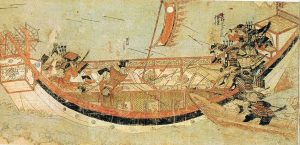
The Japanese responded by sending a small boat full of samurai to attack and board the larger enemy ship. This strategy proved effective in preventing the Mongols from landing (Yamada, 1916: 185).

For weeks the Mongols had difficulty landing. This condition caused them frustration and eventually retreated to Iki island.

In mid-July, the Southern fleet arrived. The two fleets then joined forces to attack Hirado in early August and continued the attack on Takashima located on the northwest coast of Kyushu on August 12 (Turnbull, 2010: 70).

Fierce fighting raged for several weeks. The length of the siege caused the Mongol army to run low on food reserves. On the other hand, the war coincided with the hurricane season which could come at any time.

On August 14, a typhoon known to the Japanese population as Kamikaze (wind of the gods) struck the Mongol fleet on the coastline. It is not known exactly what happened to the Mongol fleet, but according to the Chronicles Yuan about 20,000-30,000 Mongol and Korean troops who survived the storm were captured and beheaded. While the Southern Song fleet which was once a Japanese business partner is still forgiven and only jailed.

More recent archaeological evidence shows that the fleet was largely destroyed not because of the strength of the wind alone, but also because of poor ship construction (Ibid: 78). This makes sense considering the Mongol warships were made in a hurry and in a short time.

The news of the withdrawal of the Mongols until finally arrived at the Japanese government on September 23, 1281. This victory was celebrated in the Iwashimizu temple as a form of gratitude to the gods. Japan’s success in surviving surpassed everyone’s expectations, so the story of kamikaze has been passed down until now.

On the other hand, Kublai Khan actually still wanted to make a third attempt, but his soldiers had experienced fatigue due to the failure of the two invasions. Finally he chose to focus on taking care of domestic problems which at that time were in chaos (Sansom, 1958: 450).

History of India

Ancient Indian Civilization is a civilization located along the Indus River. Where is centered in the City of Mohenjodaro and Harappa. Ancient Indian civilization is estimated to have existed around 2500 BC. At that time the City of Mohenjodaro and Harappa were neatly arranged. The inhabitants of this civilization are the Dravidians. The Dravidian possessed the characteristics of a short body, pug nose, black curly hair and black skin. Where the Dravidian people have built sewers equipped with sanitation channels. Reported by Encyclopaedia Britannica (2015), Indian civilization is also called the Indus valley civilization or Harappan civilization. The civilization is estimated to have existed around 2500-1700 BC. The Indus civilization is known to consist of two major cities, Mohenjodaro and Harappa, and more than 100 villages. The two cities were originally each about 1 mile or 1.6 square kilometers.

City planning In the book of Ancient India (2008) by Maryani, at that time the City of Mohenjodaro developed into a city like Mesopotamia, Ancient Egypt and Greece. Mohanjodaro means dead mounds. Mohanjodaro is located in Sindh Province, precisely above the Pleistocene area and in the middle of the Indus River plain. At that time the Indus River Plain was a prominent and prominent area of ​​the Indus River valley civilization. In the past Mohenjodaro was one of the administrative centers of the Indus River Valley civilization. It is also one of the fastest growing cities in South Asia. Planning and technical skills show the interests of the city for the population. There has a stunning construction of buildings and consider works of art. The building has a layout based on the lane in a perfect pattern. Public facility buildings also represent high-level social organizations. The city of Mohenjodaro was built with regular city planning. Also read: Up to a Century of Human Civilizations Where to meet health and beauty requirements.

The division of the city is carried out into square or rectangular blocks. There houses were built on the edge of the highway and the door to the house faced the street. Roads are built in an orderly and straight way. The road is 10 meters wide and made like a sidewalk. There is a water channel that flows under the road and goes straight to the river. The rooms of the resident’s house have wide windows so that the air circulation is smooth. Sewage from the bathroom and latrine is connected directly to the public sewer network. Agricultural and economic systems Civilizations live by agriculture, coupled with considerable trade. Field wheat and peas, sesame seeds, and some dates stones have also been found, as well as some of the earliest known cotton traces.

Indus civilization seems to have evolved from neighboring villages using the Mesopotamian irrigation agriculture model. With sufficient community skills to reap the benefits of the vast and fertile Indus River valley. The function of the river is as a means of transportation, trade and irrigation. Also read: Inheritance of a Masterpiece of Thought of Civilization in the Middle of Corona Pagebluk Trade activity is not only in the Indus river valley but extends outside the region in connection with trade and shipping in the West Asian region. It was based on the discovery of clay stamps that used the writing of the picture turned out to be the same as similar objects found in Mesopotamia. They are also able to control the floods that occur every year. After gaining a secure foothold in the plains and mastering the more pressing problems of a new civilization, with a population that is well nourished and growing. Community life Quoted by the Ministry of Education and Culture (Kemendikbud) site, it is actually rather difficult to parse regarding the life of the Indus River valley community.

However, based on the relics of the ruins of the buildings of the City of Mohenjodaro and Harappa, it reflects a modern urban layout and has an orderly, developed and prosperous government. There were also found fortress walls which contained warehouse buildings, meeting halls and public baths. Most likely the place is the center of government. In the warehouse building serves as storage of crops. Public baths are used for bathing officials. While the meeting ward functions clearly for meetings of the authorities and government officials to plan and regulate the course of the government. Also read: 25 Years of Search, Mayan Civilization Found in Southern Mexico The Beliefs of the Indus River Valley The beliefs of the people in the Indus River valley worship the gods (polyhteism).

History Google Search And Yahoo

For all internet surfers, who doesn’t know Google? if there is possible just focus on opening a particular website and not trying to find information from various web. Google is the most famous search engine on the internet besides other search engines like altavista.com, yahoo, etc.

The word Google appears due to typos in the domain registration that was originally the word Googol coined by Milton Sirotta, a US Mathematics expert in mentioning the number 1 with 100 digits 0 (zero) behind it or it could be with the term 10 rank 100 which is intended to show that in Google has a lot of information that is almost “innumerable”.

Google was also born from a unique story of an accidental meeting between two people who were interested in the IT world. the two people are Larry Page Alumnus Univ. Michigan is 24 years old and Sergey Brain is 23 years old. they were still Masters students at Stanford University. The two met on a trip to enjoy a weekend vacation, at which time Sergey Brain accompanied Larry on a tour. On the way, the two of them discussed with each other the issue of how to recover data from massive data sets.

In January 1996, Larry and Sergey began collaborating in the creation of a search engine called the BackRub Project because it has a system that checks backlinks to estimate the significance of a site. At that time a small Search Engine named Rankdex was also conducting a similar investigation.

However, due to a setback, they both intended to sell the backrub project, but were refused. Because it cannot be sold, they want a new name for their machine. Initially they wanted the name Googol for its new search engine. A year later their unique approach to network analysis raised the reputation of BackRub / Googol. When they will buy a domain, it turns out there was an error in typing and turned into Google. Finally their search engine was used by Stanford University on google.stanford.edu.

Larry and Sergey continued to perfect Google technology throughout early 1998. Both also began to look for investors to develop Google’s technological sophistication. Tit for tat. They got an injection of funds from campus friend Andy Bechtolsheim, who is the founder of Sun Microsystems. Their meeting took place early in the morning on the porch of the Stanford faculty student dormitory, in Palo Alto. Larry and Sergey gave a short demo because Andy did not have enough time.

Through the demo, Andy agreed to provide financial assistance in the form of a check worth 100 thousand US dollars. Unfortunately, the check was written in the name of the Google company. Yet at that time a company called Google had not yet been founded by Sergey and Larry. Andy’s investment is a dilemma. Larry and Sergey would not be able to present checks as long as there is no legal institution called the Google company. Therefore, the two founders of Google are back to work hard in finding investments.

They looked for donors from family, friends, and colleagues until finally collected funds of about 1 million dollars (On September 4, 1998, Google which at that time was still based in the garage owned by a friend Larry Page and Sergey Grin had reached an investment of up to $ 1.1 million). And finally, the Google company was founded on Sept. 7, 1998 and was officially opened in Menlo Park, California.

Google’s mission is, “to gather world information and make it universally accessible and useful.” Google’s philosophy includes slogans such as “Don`t be evil”, and “Work should be challenging and challenges should be fun”, illustrating the relaxed corporate culture.

Google only moved offices in March 1999 to Palo Alto. Since that time Google has continued to grow and continue to get a lot of visits to its search engine because of its simple design and good search results.

In 2000 Google finally began to open channels of advertising based on keywords, namely Google Adwords. On September 4, 2001 Google also patented a system of ranking search results that is currently popularly called PageRank. Google’s success continues to skyrocket with more and more innovations and services that benefit internet users. It had made many other internet giants like Yahoo, even Microsoft became worried.

Even today Google continues to innovate by launching various new products such as Google Flip and is always updating and developing old products such as Picasa and Google Chrome. Even Google is also diligent in perfecting and completing various features of its products such as Google Translate, whose widgets can now be installed on all pages of the site.

Google is currently the number one company ranked in the top 100 most popular companies in America, with a number of employees around 10 thousand people.

Yahoo! is a popular web portal operated by a company called Yahoo! Inc …
Yahoo! initially just a kind of bookmark, the idea began in April 1994, when two Stanford University alumni were on vacation when their professor went out of town because of a large leave.

Engineering students David Filo and Jerry Yang have little work to do besides surfing the internet. They don’t take long to compile a large list of bookmarks, grouped by subject.

Then they think, why not put it on the web? They then work to create a database program to handle it, which can provide results online.

In March 1995, Yahoo entered into a business partnership with the owners of the Silicon Valley Venture capital. Then, they formed a partnership with Sequa Capital, a company that has a reputation in the field of investment including Apple Computers, Atari, Oracle, and Cisco Systems.

They agreed to fund Yahoo with an initial investment of close to $ 2 million. Because the realization of their new company had rapid potential growth, Jerry Yang and David began building a management team. They recruited a Motorola veteran and Stanford Engineering alumni named Tim Koogle as chief executive officer and Jeffry Mallet, Founder of Novell’s Consumer Division of Consumer as chief operating officer.

They managed to save the second round of funding in 1995 from Reuters Ltd. investors. and Softbank.

Yahoo! very successfully launched publicly in April 1996 with a total of 49 employees.

Currently, Yahoo! Inc. has become a leader in global communication via the internet, commercial, and media companies that have become a network service brand of more than 232 million individuals every month in cyberspace. As the first online navigation that guides the web, http://www.yahoo.com is the leader in the context of traffic, advertising, household needs, and business user reach.

Yahoo! is the first global internet brand to reach the biggest audience in cyberspace. The company also builds an online business with a service company that designs productivity and the web for its clients.

Designing services are included in the collaboration. Yahoo !, a customization solution for the company; audio and video streaming; shop hosting and management; and website services and equipment.

A network of global web companies is included in 25 world properties.
With headquarters in Sunnyvale, California, Yahoo! also has offices in Europe, Asia, Latin America, Australia, Canada and the United States.

History George Floyd

A black man looked in pain when his body was crushed by the police. The man named George Floyd tried to catch his breath but the more he resisted, the greater the pressure felt.

Shortly after being rescued, George just breathed his last. The BBC reports his life was helpless even though he was rushed to hospital. Public outrage culminated in this incident.

Minneapolis is again witnessing how racism continues to undermine America.

Demonstrations over the death of George Floyd could not be dammed, the crowd huddled in front of the White House and began locking up government offices, where President Trump led his country. They demand justice for Floyd’s death.

This case is not as simple as another murder case. Insulated Floyd’s breath is a vivid portrait of how the black race stood in the shadow of fear.

Keisha N. Blain, an associate professor of history at the University of Pittsburgh wrote in the Washington Post that the violence against Floyd was only two months after the death of a black woman named Breonna Taylor.

Keisha revealed that the threat of black people in Minneapolis was not a pandemic virus, but police violence.

Based on history, violence like this has happened for centuries in America. For a long time, black people were only considered slaves and their rights were limited by white people who felt confident, their position was higher than black people.

Long before George Floyd was born, around the 20th century, capital punishment did not appear as a new tactic for controlling the lives of black people.

Anti-lynching fighter, Ida B. Wells-Barnett revealed in ‘The Red Record’ that the lynching of American blacks was not only planned beforehand but was also fully supported by the local police.

During the summer of 1919, massive racial violence erupted in America. In Chicago, Eugene Williams, a black teenager was killed on July 27, 1919 for swimming in a special section of ‘white’ Lake Michigan.

Just like anger after Floyd’s death, the crowd was also furious when William was killed.

The demonstration continued for about a month and ended in August 1919 with the deaths of 15 white people, 23 black people and at least 500 people injured. This number does not include thousands of black families who lost their homes.

Continuing Keisha’s writing, the police assault on black activists during the 1963 Birmingham campaign and the 1965 Selma-to-Montgomery march were the racist roots of the American police. The violence targets black men, women and children.

Sprinting away in 2009, for the first time America had a black president. He is Barrack Hussein Obama, who was installed on January 20. Of course this is a breath of fresh air for black citizens.

Unfortunately, even though Obama has many achievements in the field of government, he is still called the root of the increasing racial problems that have occurred throughout his administration.

Back to the murder of George Floyd, if Marthin Luther King Jr. was still alive, maybe he would stare blankly at the phenomenal speech paper ‘I Have Dream’. Will justice for black people forever be a dream?