Biography of Ludwig van Beethoven

Ludwig van Beethoven is one of the greatest composers in the history of European classical music. His music includes the transition between classical and romantic styles. His work is even more remarkable considering that the works were completed when he lost his hearing function. Although the last thirty years of his life experienced hearing problems, but did not stop his steps to produce extraordinary symphonies.

Youth and Family Ludwig van Beethoven

Ludwig van Beethoven was born on December 16, 1770 in Bonn, Germany and was baptized the next day. However his date of birth is still being debated because no official documents were found, but the majority believes December 16 is the day of his birth.

His mother’s name was Maria Magdalena van Beethoven, a woman who was very serious and determined. His father, Johan van Beethoven, or his grandfather worked as palace singers for archbishop Bonn.

Unfortunately, Beethoven’s father was an alcoholic. He tried to increase family income by showing off his second son, Ludwig, as a prodigy. Nevertheless the effort was not successful.

Unlike Mozart, Beethoven’s genius took a while to fully develop. In addition to getting music lessons from his father, when he was nine years old, he also received music composing lessons from Christian Gottlo Neefe, Boon palace organ player.

Furthermore, Beethoven became an official organist assistant at the age of 14 years. During this period, Beethoven traveled to Vienna and possibly met Mozart and played music for him. However, on the way there was news that his mother had fallen ill with tuberculosis and he was forced to return to Boon when his mother died.

Journey to the Peak of Fame

After his mother died, Beethoven now became the backbone of the family, mainly because his father was increasingly unable. He also began working as a player when in the palace orchestra and the local theater. In addition, he also worked as a music teacher for children of nobility.

His position enabled him to meet many influential scientists, including the aristocratic Count Ferdinand Waldstein, an expert musician who became a friend and patron. Thanks to Waldstein’s help, Beethoven was able to go back to Vienna to learn from the famous composer Joseph Hadyn. He left Boon in 1792 and spent the rest of his life Vienna.

In Vienna, Beethoven impressed the various salons and aristocrats at the place by his virtuoso appearance on the piano. He also performed everywhere and was considered a champion in terms of improvisation, even compared to Mozart.

His compositions at that time included a number of piano sonatas, variations, and concerto. The first two symphonies show the influence of the heretics admired, Mozart and Haydn.

Hearing Loss and Beethoven’s Career Peak
In the midst of a rising career, Beethoven contracted Tinnitus in 1798. Tinnitus is a terrible disease for a composer, because it causes the sufferer to slowly become deaf and completely lose his hearing function.

With this terrible illness Beethoven experienced a bad mood and emotional shock. Beethoven had a difficult relationship and he never married.

Despite this, in the following years Beethoven still tried to continue working. He composed a number of important piano works. The compositions are brilliant and beautiful.

Even so, the deafness that he experienced increasingly became and can no longer be ignored. He was almost hopeless and perhaps realized that his career as a virtuoso was over. Therefore, he began to focus on composing songs.

In the midst of his illness, he produced a series of extraordinary works. Symphony no. 3 presented to his idol hero, Napoleon Bonaporte, marked the beginning of his masterpiece. However, when Napoleon declared himself emperor in 1804, the disappointed composer abolished the offering. The symphony was finally published in 1806 under the new title Sinfonia Eroica.

Beethoven continued his creation by producing many compositions, including Waldstein piano sonata and Appasionata; Fourth Piano Concerto; Razumovsky Quartet and Violin Concerto; and also the first and only opera that he produced, Fideho.

Symphony no. 4 and 5 were then published in this period, with no. 5 becomes an important point of musical originality. The opening of this symphony is very famous until now. Next comes the symphony no. 6, known as Pastoral, in which wind instruments mimic the sounds of local rural birds, followed by symphony no. 7 and 8 which marked the peak of their productivity period.

End of Beethoven’s Life
In the last years of his life, Beethoven did not compose much because now he is totally deaf. Beethoven’s late period works (since 1815), were marked by increasing intimacy and emotional power.

His final piano sonatas, opus 109, 110 and 111 are extraordinary works of virtuoso with complexity in perfect harmony with lyricalism.

On the other hand, Symphony No. 9, the great work created in 1823, exploded with the last movement, Ode to Joy. The movement featured full choir and passionate solo singers.

His last string quartet was completed in 1826, which coincided with Beethoven’s nephew who was also his guardian. One year later he was attacked by pneumonia and the appearance of cirrhosis of the liver which caused his death on March 26, 1827 at the age of 56 years.

Beethoven was buried with an extraordinary ceremony in Vienna. A ceremony suitable for composers who have been famous throughout Europe. Until now, his name is coupled with the ranks of great composers of his time or other times.
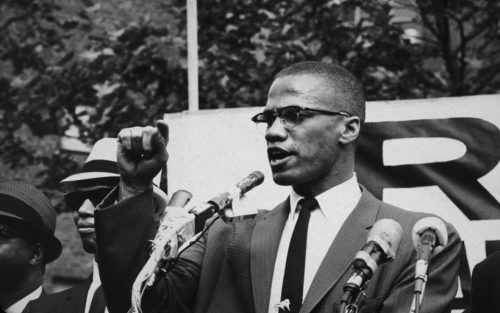
Biography of Malcolm X

Malcolm X or also known as el-Hajj Malik el-Shabazz is an African-American Muslim leader, advocate civil rights and human rights for blacks, as well as supporters of the idea of ​​Pan-African and Pan-Islamism. After his death, the spread of his autobiography made Malcolm an ideological hero, especially among black youth.

Dark Life Malcolm X

Malcolm X is real name Malcolm Little. He was born on May 19, 1925 in Omaha, Nebraska to uneducated, poor, Christian and black nationalist supporters.

He believed that the white man had killed his father and unfairly placed his mother in a mental hospital, and put himself and his siblings in a different orphanage.

At the age of fifteen, when Malcolm finished eighth grade, he realized that he hated formal education and established religious education. The dark background led him to the black world.

In these gloomy times he was nothing more than a lazy atheist. He became a drug addict and participated in illicit trafficking, gambling and robbery when he needed money.

Repentance Malcolm X
In 1946 Malcolm was sent to prison for theft. The event marked the beginning of his intellectual and social transition. Thanks to the encouragement of John Bembry, his friend in prison, he began to learn to write and read books.

The prison is a place to read Western and Eastern books of philosophy and literature, works on Christianity, genetics, and American slavery. The reading range exceeds the average reading of American undergraduate level. From his informal education he also knows the teachings of Islam and the history of Muslim heroism.

Through the encouragement of his brother Reginald and his colleagues in prison, in 1948 Malcolm turned to the doctrine of Elijah Muhammad, leader of the Nation of Islam. He was intrigued by Elijah’s main doctrine that a black God would free the Arika-Americans and destroy their oppressive skin demon.

The spirit that Elijah brought was in accordance with the conditions faced by black Americans, where racial discrimination at that time was very strong.

After joining the Nation, Bliss stopped smoking and gambling and refused to eat pork. He also changed his last name from Little to X, a custom among Nation of Islam followers who thought their family name came from white slaves.

After being released from prison, Malcolm helped lead the Nation of Islam during a time of greatest growth and influence. He met with Elijah Muhammad in Chicago in 1952 and then began to arrange mosques for the Nation in New York, Philadelphia and Boston and in cities in the South.

Malcolm then founded the Nation newspaper, Muhammad Speaks, which he printed in the basement of his house. Then it initiated a practice that requires every male member of the State to sell a number of newspapers on the street as a recruiting and fundraising technique. He also articulated the Nation’s racial doctrine about the evil inherent in white people and the natural superiority of black people.

Malcolm’s social experience, intellectual achievements, and his dedication to leaders led him to a high position in the Nation of Islam.

At first Malcolm was appointed as the leader of the Number 11 Mosque in Boston, then in mid-1954, Malcolm was appointed by Elijah as the leader of the Number 7 Mosque in the Harlem District, New York. This mosque is the second largest mosque in the Nation after the mosque in Chicago.

In 1958, Malcolm married Betty Sanders and from this marriage he was blessed with six children.

As the Third World and US political activities continued to develop in the late 1950s and early 1960s, Malcolm increasingly dared to issue anti-racism statements. He openly supports the freedom of African-Americans, Africans and Muslims.

Even Malcolm did not hesitate to criticize Elijah’s protective policies and avoidance of unnecessary contacts with Sunni Muslims.

Conflict between Malcolm X and Elijah Muhammad
From 1959 onwards, Malcolm’s efforts to modify Elijah’s policy made his loyalty questionable.

His short visit to Saudi Arabia and African countries, as Elijah’s envoy, as well as the national broadcast “The Hate That Hate Produced”, further strengthened his popularity. On the other hand, however, the rising popularity caused many Nation members to envy him.

Malcolm was disappointed that Elijah Muhammad’s visit to Muslim countries in 1959, as well as his Umrah, did not bring much political change to the Nation.

Malcolm gradually changed administration at the Elijah Mosque Number Seven. Despite always responding sharply to Sunni Muslim criticism of Nation’s theology, he continued to teach Arabic and maintain good relations with other Muslim diplomats.

Furthermore, Malcolm began to play down the Nation’s doctrine of “the nature of the devil in white and the natural superiority of blacks.” He taught his assistants with African and Asian culture, and the warm problems of the period. This change shows the role of social and political activists without the restrictions they want to live.

In 1963 there was a strong tension between Malcolm and Elijah Muhammad regarding the political direction of the organization. Malcolm urged that the Nation be more active in widespread civil rights demonstrations and not just be a fringe critic.

Muhammad’s violation of the Nation’s code of conduct further exacerbated his relationship with Malcolm, who was devastated to learn that Muhammad was the father of the children of six of his personal secretaries. Two of them even filed a paternal complaint and made this issue public.

Malcolm brought bad publicity to the Nation when he publicly announced that the assassination of John F. Kennedy was an example of “chickens coming home to roost” (a violent society suffering from violence). In response to this provocative statement, Elijah Muhammad suspended Malcolm for 90 days and the rift between the two leaders became permanent.

Malcolm finally left the Nation in March 1964 and the following month founded the Muslim Mosque, Inc. During the pilgrimage to Mecca that same year, he underwent a second conversion and embraced Sunni Islam, adopting the Muslim name, el-Hajj Malik el-Shabazz.

After leaving the Nation’s theology, he claimed that the best solution to racial problems in the United States was a return to Islam based on the Koran and Hadith.

On his second visit to Africa in 1964, he spoke for the Organization of African Unity (known as the African Union since 2002), an intergovernmental group formed to promote unity, international cooperation, and economic development in Africa.

In 1965 he founded the Afro-American Union Organization as a secular vehicle to internationalize the plight of black Americans, and to move from a civil rights struggle to human rights.

The animosity that developed between Malcolm and the Nation led to death threats and violence against him. On February 21, 1965, Malcolm was killed while giving a lecture at the Audubon Ballroom in Harlem; three members of the Nation of Islam were convicted of the murder.

His struggles, ideas and lectures contributed to the development of black nationalist ideologies and Black organization movements. Malcolm also helped popularize the values ​​of autonomy and independence among Afro-Americans in the 1960s and 70s.